This website will offer limited functionality in this browser. We only support the recent versions of major browsers like Chrome, Firefox, Safari, and Edge.
I don’t want to give away my age, but I will say this: I’ve heard some of today’s arguments about technology like AI before. Almost word for word.
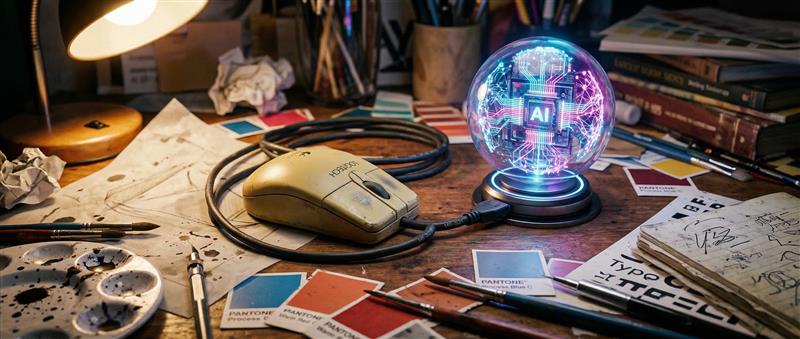
I stepped into the creative industry in the early-mid 1990s, a digital revolution was happening! I remember the transition to the era of desktop computers in the industry and, eventually, the internet. There was a real anxiety that the manual skills we had spent years celebrating were suddenly becoming less relevant. Designers who had mastered paste-up were expected to learn software that crashed every forty minutes.
People said the computer would kill creativity. That it would make everything look the same. That the craft would disappear. They were wrong, of course.
As agencies evolved into full-service, one-stop shops for creative capabilities, absorbing design, typesetting, and production that had previously been farmed out to specialists, a vital truth emerged: the tools had changed, but the foundation and principles of great design remained exactly the same. Those principles were what made you better than someone who simply knew how to operate the software.
I see the same pattern now with AI. The same excitement. The same fear. And, if I’m being honest, many of the same mistakes. But there is a difference this time, and it’s one we cannot afford to underestimate: the sheer speed of adoption.
In the UK, just twenty-three percent of businesses are using AI*, less than half the adoption rate seen in the US. But the effect it is having across the creative industries is real, and I fully acknowledge the concerns. But I also embrace it. I have always been an early adopter of technology because I believe in a simple philosophy: we shouldn’t fear change; we need to drive it, both creatively and responsibly.
THE JOY OF CURIOSITY
When artificial intelligence arrived on the creative scene, my natural inquisitiveness took over. I found myself constantly tinkering. Not just to see what AI could do, but to truly understand how and work with it.
The practical benefits became clear quickly. Retouching work that required sourcing additional stock images could be handled within Photoshop’s generative fill. Research that took days of reading could be summarised in minutes, so we could interrogate the human truth behind the data rather than just processing it.
But there was something else I hadn’t expected. I started to realise I could explore ideas across different media in ways that simply weren’t practical before. AI made me more adaptable. More multi-faceted. In our industry, the word for this is often “generalist,” and it tends to carry a slightly dismissive tone, as though breadth comes at the expense of depth. But a generalist, properly defined, is someone with competence across multiple disciplines who can see how ideas connect and translate between them. That is not a weakness. In an AI-assisted creative environment, it is arguably the most valuable skill you can have.
To evaluate these tools properly and share what we’ve found with the wider team meant we could enhance both the quality and the speed of our output. Not one or the other. But both through collaboration, not Automation.
One of the strongest convictions I have formed through working with AI is this: collaboration gets better results than delegation. The best output comes NOT from writing a brief prompt to a machine and accepting what comes back, but from working with it iteratively. Directing it, refining it, pushing it, and combining its speed with your own judgement and craft. Core skills have not become less important. If anything, they matter more now than ever. A designer who understands typography, hierarchy, colour theory, and composition will use AI to produce work that is visually literate and intentional. A designer without those foundations will produce something that looks plausible but feels empty. The same applies to copywriting, to strategy, to production. AI amplifies whatever you bring to it. If you bring deep skill, you get elevated work. If you bring nothing, you get generic output.
This is the reality that will define the next decade of our industry. A mix of practical skill and AI can absolutely coexist. That combination is what will elevate you above someone who simply automates their creative with generic content. The people who treat AI as a collaborator, who bring their expertise to the conversation and use the technology to extend their reach rather than replace their thinking, are the ones who will produce work that stands apart.
AI CANNOT TELL GOOD FROM BAD. THAT’S OUR JOB
This sounds simple, but it is the most important thing I can say about working with AI: it cannot distinguish between good and bad. It has no aesthetic judgement. It has no sense of what’s appropriate, what’s off-brand, or what will land differently in one market versus another. It generates with equal confidence whether the output is brilliant or mediocre. It does not know the difference, and it does not care.
That ability to evaluate, to challenge, to recognise quality, is our skill. It is the thing that separates a professional from someone who can operate a prompt. And yet, what I see happening is troubling. People accept the first answer AI gives them. Every time. They type a prompt, receive a response, and move on as though the machine has delivered a definitive answer rather than a best guess.
This is not how you get good work. You would never accept your first rough without interrogating the rationale behind it. AI should be treated with the same critical eye. Push back on it. Ask it to justify its reasoning. Request alternatives. Give it constraints and see how it responds. The tool is only as good as the person directing it, and direction means challenge, not passive acceptance. We must drive AI, not be led by it.
THE GREY AREA WE CANNOT AFFORD TO IGNORE
There is a conversation happening in boardrooms and creative departments that is not getting the attention it deserves. Where does the imagery you are using actually come from?
Many of the most popular image generation platforms, the ones that produce the most visually striking results and attract the most headlines, were trained on datasets scraped from the open internet. That means they have ingested copyrighted photographs, illustrations, artwork, and design without the consent of the original creators.
The legal landscape surrounding this is still evolving. Our own government has recently gone back to the drawing board after condemnation from the creative industry around proposed regulation*. But the direction is clear. Lawsuits are mounting. Regulatory scrutiny is increasing. And the fundamental question brands need to ask themselves is straightforward.
If you cannot provide a paper trail for how an image was created, what data trained the model, what source material informed the output, and whether the rights to that material were properly licensed, then you are building on uncertain ground.
For internal brainstorming or early-stage concepting, the risk is be manageable. But for client brand content, the assets that appear on packaging, in retail environments, across paid media, and on social platforms, the standard has to be higher. If a competitor, a rights holder, or a regulator ever asks how a particular image was produced, the answer needs to be clear, documented, and legally defensible. “We typed a prompt into said image generator” is not going to be sufficient. That grey area is going to create real problems down the road for brands and agencies that do not take it seriously now.
This is why we made the decision to build our creative AI workflows around ethically trained models. For client-facing production, we work within the Adobe ecosystem, where the generative AI is trained exclusively on licensed stock content and Adobe’s own library, not on material scraped from the open web. This provides commercial indemnification. A contractual guarantee that the assets we create are commercially safe, protecting our clients from third party IP claims. Governance shouldn’t be a constraint on innovation. It is the foundation that makes responsible innovation possible.
A WORD TO THE NEXT GENERATION
With all the buzz around AI there is understandably a lot of uneasiness, especially from younger creatives entering an industry that feels like it’s shifting beneath their feet. Just remember those traditional skills didn’t become suddenly irrelevant. They just become the foundation for everything that comes next.
It is easy to look at this landscape and feel defeated before you start. When an algorithm can generate a polished layout in seconds, that blank page feels less like an opportunity and just intimidating. But the industry is selling a myth right now: that the ultimate skill of the future is prompt engineering. It isn’t. The real differentiator is creative ownership. AI is fantastic at generating happy accidents. It takes a human to steer it to something meaningful. AI is a tool not a shortcut or replacement.
The model we see working well now is experienced professionals using AI to multiply what they can do. But nobody is asking what happens in ten years when those people step back. If the juniors coming through have spent their formative years accepting AI outputs instead of developing their own eye, their own taste, their own ability to look at something and know it isn’t good enough, then we have a serious problem.
The industry won’t just lose senior talent. It will lose the next capable senior talent. We need to be honest about that. Investing in the next generation means giving them space to develop judgement, not just a proficiency with tools. The people who can do both will be the most valuable in the room. The people who can only do one will be replaceable by the next software update.
So fiercely protect your empathy, design principles, critical thinking. Invest in your core skills, the fundamentals of design, communication, and craft, because those are the things that will elevate your AI-assisted work. And above all, never accept the first answer. Challenge it. Push it. Make it earn its place in the work.
CREATIVITY IS STILL THE MAGIC ELEMENT
We cannot escape AI. The question is not whether it will reshape our industry. The question is what we choose to do about it.
Creativity remains our most powerful competitive advantage. With all the noise about efficiency and speed, it is still what drives real value. It matters for our people, for our agencies, for our clients, for their businesses, and for the wider economy. So if AI is inevitable, then what we can do is champion authenticity. We can deepen our understanding of the occasions where our work truly matters, the moments that resonate with our clients’ brands and the people who buy them. We can focus on what makes communication land, not just what makes it fast.
AI is just patterns and algorithms. It is prediction. It is probability. It is very good at the average of everything it has ever seen. So let’s complement it with the things it will never have.
Our depth. Our chaos. Our creativity. No model can predict. The instinct that says this colour, this word, this image will stop someone in their tracks. Those are not inefficiencies to be optimised. They are the reason our work connects.
The next leaps in creative thinking will come from people who understand how to harness AI as an accelerator. People who can move between the analytical and the intuitive, between the data and the feeling, between the logic and the magic.
Thirty years ago, I watched an entire production ecosystem transform. The repro houses became the internet. The typesetter became the designer. The studio became the agency. Each time, the people who thrived were not the ones who clung to the old tools or feared the new ones. They were the ones who stayed curious, kept tinkering, who understood that the technology was never the point.
The thinking was always the point. AI will continue to evolve. Our roles will likely shift from producing every finished asset to designing the creative blueprints, the brand rules, the guardrails and templates, that AI then follows at scale. An age of ecosystems, where human-driven creativity commands an authenticity premium and our most valuable asset is not what we produce, but the judgement, empathy, and cultural intelligence we bring to the process.
AI is not going anywhere. But neither are we. The difference is that we get to decide what we bring to the table. And what we bring is the thing no algorithm can replicate.