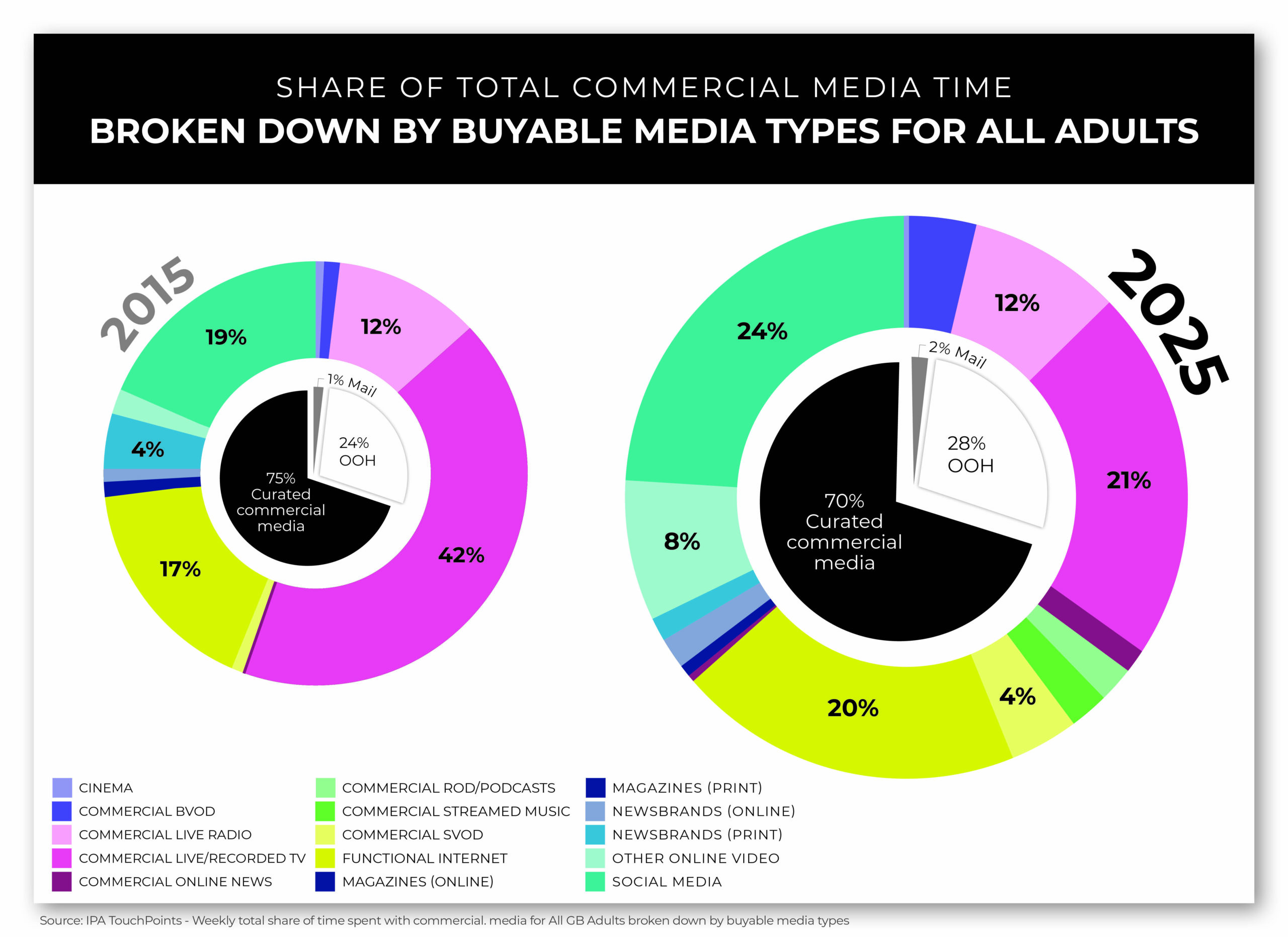

Each year, the IPA produces ‘Making Sense: The Commercial Media Landscape,’ a report that highlights the state of the media landscape, what fundamental changes we’ve seen and what’s remained the same. Now in its seventh year it’s a report that allows marketers, strategists, and advertisers a moment to reflect and make sense of the last 12 months in advertising. The report uses the latest IPA Touchpoints data and provides a holistic view of how commercial media consumption has shifted in the past year, and most importantly why these changes matter to our planning.

Evolution not revolution
Over the years, headlines have warned of the demise of traditional media and as marketeers we’ve been frantically tracking these patterns in the hope of seeing some eureka moment. Although it’s fair to say new media consumptions have been emerging, with some traditional forms of media having taken a dip. These media channels are by no means dying, they are simply evolving, trying to use new and innovative technologies to reach both their existing and new audiences. The media landscape is fragmented, and whilst this statement is nothing new, the extent of media fragmentation continues to grow. With media fragmentation comes consumer choice, and with consumer choice comes a crowded and complex landscape for marketeers to navigate.
Using data, we can see that instead of media channels dying, delivery methods are evolving in line with available technology. While consumer needs remain largely unchanged, the ways audiences engage with them have transformed. We see TV, radio, print, and out-of-home (OOH) advertising continuing to play vital roles, but with choice we can see live and recorded TV has declined in share and being watched via broadcaster video-on-demand (BVoD), subscription video-on-demand (SVoD), and other online video formats such as YouTube.
Equally, while there’s a clear drop in the proportion of news being accessed through traditional print channels, we’re seeing a noticeable increase in people turning to digital formats, like online versions of print publications, to meet those same information needs. In other words, the shift away from print is matched by growth in digital news consumption.
Smartphone reigns supreme over the humble TV Set
As we’ve already reported in our previous blog “Phone Has Taken the Throne” one of the most seismic shifts in 2025 is the rise of the smartphone, and how for the first time, phone screentime (35%) has overtaken the TV set (34%) for commercial media consumption by device, based on an all adults audience. Although when looking at the 16–34s age group, this age group is responsible for the shift, accounting for 50% of all screen time. For this audience, the TV set’s share has dropped, as expected, to 22% Whilst this shows the fluctuation in device usage, it’s likely that this drop in TV set viewing is partly due to people choosing to access the same content via their smartphones rather than the big screen, along with the growing prevalence of mobile devices and the flexibility they offer for consuming content anywhere, anytime.


Plans need to reflect the fragmentation
As media practitioners whilst we can observe shifts in the media landscape, and appreciate these changes are profound and have never been more crowded or complex. With fragmentation now the norm, this means the ability to achieve broad reach through a single channel, is no longer possible (apart from OOH), no singular channel reaches over 90% of all adults weekly. This fragmentation needs to be reflected in our planning, and highlights the need for integrated, multichannel strategies that combine digital and non-digital media, driving incremental reach through a multi-channel approach.
The Rise of AI: Tool for Exploration, Not Just Efficiency
Equally featured in our blog series “A year on, how has AI adapted” it’s fair to say, AI has been on the agenda for media planners for some time. And whilst AI can promise a world of efficiencies by streamlining processes and developing new opportunities, the report provides some words of warning against stopping short with AI and seeing it solely as a tool for efficiency and exploitation. Instead, we need to embrace AI with an explorative mindset, allowing for testing, learning, and innovation. Under the ethos that “rubbish in equals rubbish out”, we need to consider how we provide AI with quality inputs and review what’s worked or hasn’t worked over time for continual learning and long-term effectiveness.


The Over 55s
Gone are the days of considering this audience as digitally inept. Even terms such as silver surfers now seem derogatory to this audience, who are rising in digital adoption, never too far away from their Meta feed and regularly stream digital audio. Yet despite their potential for growth, they remain largely untapped and one of the most underrated and underutilised audiences. With high levels of disposable income, these audiences are valuable to brands and growth. Brands need to do more to tap into these audiences by developing media plans that reflect their media habits.
Commercial or digital, ad funded remains strong
Despite the media fragmentation, we see commercial media remains strong. Looking at an ‘All Adults’ audience in 2025, 67% of time was spent with commercial ad-funded channels, with more time spent on digital than non-digital channels. The split has grown from 58% in favour of non-digital in 2015 to 63% in favour of digital in 2025. And like with the smartphone usage, this percentage is higher again for the 16–34s age group, with a whopping 70% of their commercial media time is ad-funded, and 83% percent of this time is spent on digital channels.