

Google’s rapid rollout of AI-generated answers at the top of results, most notably through AI Overviews and its emerging AI Mode, marks the biggest shift in search behaviour since the arrival of mobile. Instead of simply directing users to websites, Google is increasingly becoming the destination – using AI to summarise information, research more deeply, and answer queries directly on the results page.
For UK brands, publishers and advertisers, this raises an unavoidable question: if users don’t need to click, what happens next?
From highly ranked listings to condensed informative snapshots
In May 2024 Google began rolling out its new artificial intelligence-powered search feature, called AI Overviews. These overviews used generative AI to provide the user with a synopsis of information taken directly from multiple top ranked results. Shown above the search rankings, it provides users with quick answers without the need for clicking on multiple websites.
From a user perspective, the appeal is obvious. Users have the answers to a range of complex questions, quickly and without needing to spend time sifting through multiple websites, with loads of open tabs or scan long articles. From a user’s point of view this overview saves time, offering what users need, and much faster.
However, from a marketing perspective, this changes the way search works and therefore impacts the value of ranking highly. Why would you need to rank highly if the answer is pulled out, condensed and served to the user already at the top of the page, there really is little too no incentive to click, even more so for informational and research-based queries.
This shift becomes even more noticeable with Google’s AI Mode, which uses more back-and-forth AI driven dialogue to tailor the result, moving away from the familiar list of rankings.
Rather than the engine or mechanism to getting to the result – Google is becoming the result.
Why visibility no longer guarantees traffic
The consequence of this shift in AI adoption is that some websites will lose their visibility and their traffic.
This risk, that at one point was theoretical, is now playing out as reality, with reports of sever impact being seen, and some reporting that AI overviews are contributing to an 89% drop in click-through-rates.
Publishers’ concerns are not just about the volume of traffic on their website, but the wider implications of fewer web visitors. Fewer visits directly impacts ad impressions (your ad will start to show less if it’s not clicked once searched), booking revenue and lead generation, particularly for businesses that rely on web-based conversions.
Even though being summarised by the AI generated information might add some value, it doesn’t come close in value to actual web visits.

Paid search enters a more complex ecosystem
AI generated SERPs are impacting organic visibility and redefining how and where ads are shown.
Google has now confirmed that paid advertising and sponsored ads will be included within the AI generated overviews, creating new paid placements inserted into the generative AI responses. From Google’s point of view, it’s another revenue stream, but from an advertiser’s point of view, it creates a sense of uncertainty and may undervalue the authenticity generative AI currently provides users.
On one hand, appearing within an AI-generated response could align brands with the moment of intent, on the other, this raises concerns around ad prioritisation, user experience, transparency and trust.
If paid placements are included within AI-generated results, how easily will users be able to distinguish between authentic information and paid for ads? And will performance metrics be able to report successfully when they are so heavily reliant on clicks and attribution for performance data?
Consumer behaviour is already shifting
Consumers and AI – UK – 2025 – Mintel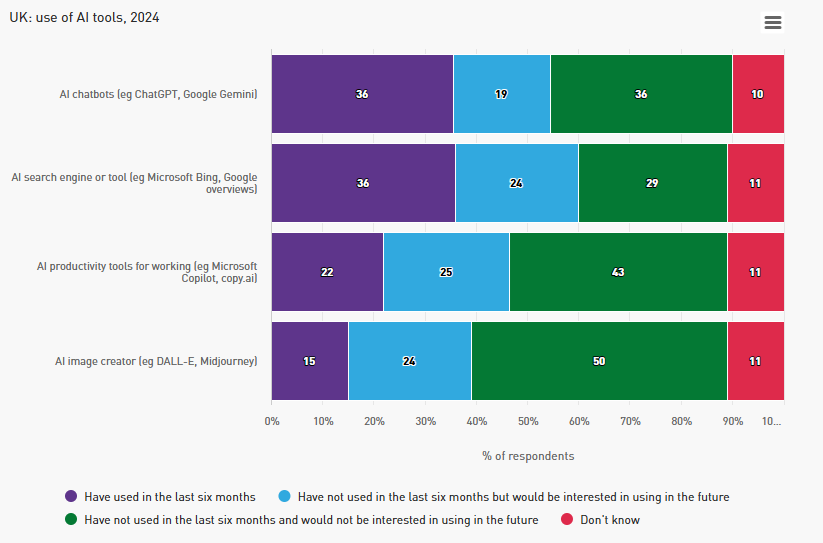
While AI enhanced SERP are becoming widely accepted, not all UK customers are accepting the change.
Through Mintel data we can see that 36% of UK internet users who are aware of AI say they’ve used an AI search tool such as Google Overviews or Bing within the last six months. Although this is considered a strong adoption rate the data also shows that UK customers are approaching AI with some level of caution.
Almost half of UK consumers say they do not trust AI chatbot search results, and 73% of AI search users report double-checking answers elsewhere. AI is a great tool, but as we’re all increasingly aware, it’s only as good as the information we put into it, and sometimes it can provide misleading or even inaccurate information as it always tries to appease the user. This cautious approach to AI adoption matters as it suggested that while AI is being used widely for research purposes, it’s not been fully adopted, and human intervention and judgement is still hugely important.
For marketers, this creates a real unprecedented and unfamiliar landscape. While AI generated SERPs may reduce the performance of bottom funnel activity, further down in the user journey, customers are still valuing brand credibility, brand trust and depth of offering, particularly for the more considered purchase such as finance, travel, healthcare, education and high-value retail categories.
In addition, while we’re seeing a seismic shift with AI‑driven search and discovery, negatively impacting click‑throughs, Mintel reports also highlight that LLM (large language model) AI tools are transforming the way people shop. In turn, this is helping to generate referral traffic. Recent Adobe research shows that visits to UK retailer websites from AI sources have risen by 1,100% since August 2024.
This demonstrates that while AI may directly impact clicks, it can also act as a highly qualified referral engine, particularly further down the purchasing journey. Brands that offer clear value beyond a simple summary, such as lean pricing, a clear product offering, or a strong brand identity, are therefore more likely to benefit in the new AI‑driven results landscape.
What marketers should do now (5 quick actions)
-
Audit your priority queries to see where AI Overviews appear, and track click-through-rate changes on those terms.
-
Strengthen key pages with value AI can’t easily compress: original insight/data, clear point of view, tools/templates, rich visuals, and experience-led guidance.
-
Make expertise obvious: named authors, credentials, up-to-date content, and clear sources (so your content is both trusted by people and legible to machines).
-
Recalibrate paid search expectations: test how AI placements affect performance, and plan for journeys where visibility influences conversions without a direct click.
-
Update measurement to capture visibility without clicks: impression-led KPIs, assisted conversions, brand search lift, and lead quality indicators.