

August 5th, 2026
More Data Won’t Save Us: The role of evidence in modern marketing strategy.
Dan Eatly,
We’ve never had more data, more research or more AI at our fingertips. So why does deciding what to actually do feel harder than ever?
This was the subject of our latest Effectiveness Sessions webinar series which I hosted. Opening with a simple poll, I asked the room which of four things had increased the most in their day-to-day work over the last three years:
-
the data available to them
-
the time to think
-
the confidence in their decisions
-
or the clarity on what to prioritise.
You can probably guess where it landed. An overwhelming skew towards data available to you.
And there’s the irony, isn’t it? The answer to a question about having too much data was… more data. But it made the point better than any slide could. Because if data alone made us better decision-makers, we’d all be brilliant by now.
The problem isn’t a shortage of information
We’re drowning in the stuff. Supermetrics’ 2025 Marketing Data Report found marketers are now working with 230% more data than in 2020. Yet in the same breath, 56% of us say we don’t have time to analyse their data properly, and 26% say finding the relevant insight is their single biggest challenge.
More inputs. More noise. Less time to think.
So, our job as strategists and marketers has quietly got more convoluted, not less. Which means the question we should be asking isn’t “how do we get more data?” – we’ve got that in abundance. It’s “what evidence actually helps us make better decisions?”.
That’s a different question entirely.
And answering it well comes down to three things: knowing the types of evidence you’re working with, spotting the traps that quietly erode your thinking, and being honest about where AI genuinely helps and where it really doesn’t.
Three types of evidence that shape better decisions
I’ve found it useful to think about evidence in three buckets. It’s not a hard-and-fast rule, more of a lens, a bit of structure to make decision-making feel a little easier. Each one answers a different question. Each has real strengths and real limitations. And the strongest strategies use all three.
Let me bring it to life with a campaign we ran for Transport for Wales (TfW).
The brief was a serious one. Between April 2021 and March 2022, 15 people lost their lives trespassing on railway lines, and Cardiff and the Valleys saw over 1,000 recorded instances of anti-social behaviour on the railway. With the rollout of overhead line equipment as part of the Metro electrification, those lines were now carrying 25,000 volts. Behaviour that had always been risky had become potentially fatal. We needed to keep people safe.
Here’s how the three types of evidence each did their bit.
-
Data – what is happening?
This is the evidence we all know well. Performance metrics, tracking data, dashboards, survey numbers. It’s brilliant for describing scale, spotting patterns and telling you what is going on.
What it rarely tells you is why. It shows you the behaviour, not the motivation behind it. And the moment we treat data as the whole picture, decision-making starts to get harder.
For TfW, we were handed a vast Excel document – line after line of every recorded incident: what happened, when, where, and who was involved. From that, we could see exactly who was most likely to be trespassing, where, and when. It pointed clearly to young males in the Valleys regions. But it didn’t tell us the one thing we most needed to know: why they were doing it.
-
Behavioural insight – why is it happening?
This is where we move from what to why. It doesn’t come with the neat numbers of a dashboard, and it doesn’t scale in the same way, which is exactly why it so often gets under-played in decisions. It’s harder to gather and it can cost more, so it quietly gets squeezed out. That’s a mistake.
We ran focus groups with young males living along the Valley lines. And what we heard reframed everything. To them, they weren’t doing anything wrong. They’d grown up taking shortcuts across the tracks on the way home from school, or nipping over to fetch a football. It wasn’t malicious. It wasn’t, in their minds, even dangerous. It was just what you did – and had been for generations.
That was the unlock. The big change was that the electrification made it lethal even when no train was coming. Which led us straight to the core insight: something they’d always got away with, they were now unlikely to get away with again. And that became the campaign platform – No Second Chances.
-
Cultural understanding – what does this mean in context?
This is the context that behaviour sits within, social norms, language, identity, community dynamics, the cultural signals an audience reads without thinking. It’s what makes a campaign feel like it belongs to people rather than being aimed at them. In a place like Wales, where cultural, linguistic and regional identity carry so much weight, you ignore it at your peril.
It’s arguably the most important of the three and by some distance the hardest. Its biggest limitation is that we assume we understand it, when we often don’t.
From our audience, we learned that old-school safety messaging simply didn’t wash. It switched them off. So, we borrowed from the world they were actually living in. At the time, Vinted and Depop and the whole vintage-fashion resale scene were part of their zeitgeist. So, we leaned into it, which included setting up a pop-up “shop”, where the clothes weren’t for sale but had been made to look as though they’d been through the electrified line. A deadly serious message, told in a language that audience actually spoke.
The key: balance, not volume
Data gave us the who, where and when. Behavioural insight gave us the why, and the platform. Cultural understanding gave us the how – how to land it so people would sit up and take notice.
You don’t need equal amounts of each. You can be deliberate about which one does the heavy lifting for a given decision. But you do need to make sure you’re not asking one type of evidence to paint the whole picture. So, the question worth asking yourself, every time:
Am I really using all the evidence available to me, or am I leaning too heavily on one type and overlooking the others?
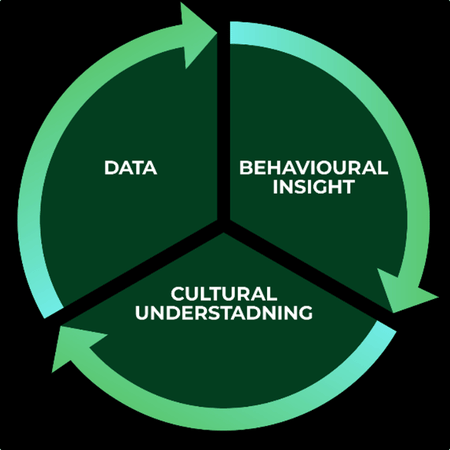
Where decision-making quietly gets harder
Here’s the thing: most of us don’t get this wrong on purpose. There are just patterns, and methods, that are very easy to slip into. Three of them come up again and again.
Trap one: over-reliance on metrics and dashboards
This is the most familiar one, and I’ll hold my hand up, I’ve been as guilty of it as anyone.
We optimise the metrics that move fastest, because those are the ones we can see. We start confusing activity with impact. And because dashboards look so precise, we end up more confident than the underlying evidence really justifies.
You know the scenario. Engagement’s up, click-throughs are healthy, sentiment’s positive, the whole dashboard is a lovely shade of green but the behaviour you actually set out to change isn’t shifting. It’s tempting to call that a win rather than asking the harder question of why nothing’s really changing.
The classic example is Airbnb. During COVID, they cut most of their performance marketing and their traffic and bookings barely dropped. Brian Chesky, co-founder and CEO of Airbnb later said publicly, that they’d been “spending money on things that weren’t actually driving growth – the dashboards said they were.” They redirected that spend into brand, built the Belong Anywhere platform, and became more effective in the long-term.
The dashboard had been telling a story that the behaviour just didn’t back up.
Trap two: underdeveloped human insight
This is almost the opposite problem – where audiences get described but never really understood.
We know their age, their region, their media habits, maybe their attitudes at a top level. But we don’t always know what actually motivates them, what tensions they’re navigating, or why they behave one way in one context and differently in another. And we can be far too quick to take third-party research as gospel. “40% of Gen Z think this” – great, but there are a hundred nuances living inside that number, and it’s on us to stress-test them.
The cautionary tale here is, the well documented, Pepsi and the Kendall Jenner ad. The assumption was that Gen Z were all about purpose and protest, so the thinking went: drop Kendall into a protest, hand a police officer a Pepsi, job done. It backfired spectacularly because they hadn’t done the work to understand what that audience actually cared about and how brands should integrate themselves. And when you show up to a movement with nothing to offer it, people see straight through you.
You’ll rarely have the scale here that data gives you. Sometimes it’s one or two comments in a focus group. But you have to have the confidence and the gut instinct to recognise when those ‘couple of comments’ carry real weight.
Trap three: one type of evidence dominating
Usually, it’s data. Sometimes it’s gut instinct. Sometimes it’s the opinion of the most senior person in the room, or a cultural assumption you’ve built from three articles you happened to read. Increasingly, it’s whatever AI told you.
Whenever one type takes over, the same three things happen, quietly:
-
Confidence rises, but clarity falls.
-
Strategy starts to feel generic because it isn’t grounded in a full picture.
-
And effectiveness quietly erodes.
What we need is the space to step back, ask the right questions, and hold onto our judgement.
Where AI helps – and where it really doesn’t
We can’t have an honest conversation about evidence in 2026 without facing AI head on. It’s brilliant at surfacing information and data quickly. It’s also perfectly capable of making enormous assumptions, oversimplifying human behaviour and misreading cultural context. So, let’s be clear about which is which.
Where it genuinely helps me:
-
Synthesis. Feed it interview transcripts, open-text survey data or trend research and it’ll surface patterns and themes fast. It doesn’t replace interpretation, but it gets you to the point where interpretation is useful in a fraction of the time.
-
Speed. It’s transformed my early-stage thinking. Two years ago I’d have had nothing on paper for hours, sometimes days. Now I get to a rough version quickly and spend my time making it better.
-
Drafting. Never for final work. But for getting to a first version faster, so the human graft of refining and sharpening can start sooner.
-
Support. A genuinely useful thinking partner and sounding board, great for pressure-testing your own logic before it hits a room.
Where it shouldn’t be trusted:
-
Judgement. Deciding which piece of evidence matters most is a fundamentally strategic act. AI can offer options and even recommend a route. But it can’t take responsibility for the decision, and it can’t feel the weight of it the way you have to.
-
Nuance. Emotion, culture, tone, identity – AI can recognise these on the surface, but it can’t feel them.
-
Motivation. Understanding why people do what they do – the tensions, the contradictions, the human context – remains deeply human. And I hope it stays that way.
-
Trade-offs. Real strategy involves ambiguity: choosing what to prioritise, what to leave out, what risk to accept. That’s a judgement AI can support but not replace.
The bit I wrestle with most is what AI leaves out. What I always valued was reading a piece of research and instinctively knowing what to keep and what to set aside. AI hands you a tidy synthesis but you never see what it quietly discarded. And sometimes the thing left on the cutting-room floor is the very detail that gets a campaign ticking. Some things just take time.
So, my rule is simple: AI is for augmentation, not authority. Use it to make yourself faster, broader and more thorough. Then reinvest that time in the judgement, the nuance and the trade-offs. Because AI can make strategists faster, but the best strategists are the ones who make AI useful.
Three principles to build confidence into your decision-making
Anyone who’s worked with me knows I’m a sucker for the rule of three. So, here’s where it all lands. Three principles you can take into your day-to-day tomorrow.
-
Start with the decision, not the data. It sounds obvious, but so much strategy starts the wrong way round. We open the dashboard that’s easiest to access, let it shape our thinking, and end up describing what’s happening rather than deciding what to do about it. Before you open a tab or type a prompt, ask: what decision are we actually trying to make here? Prioritising an audience? Repositioning a brand? Shifting budget between long and short term? Each needs a different type of evidence and once you’re clear on the decision, the right evidence is far easier to spot.
-
Balance beats volume. Back to the framework. Don’t lean too heavily on any one type of evidence. You don’t need equal measures of each, just make sure you’ve explored all three, and worked out what each is telling you and what it isn’t. The strongest decisions come from balance, every time.
-
Use AI as augmentation, not authority. Let it speed up your thinking, not replace it. Keep judgement, nuance and motivation firmly human. AI can make you faster but only better judgement makes you more effective.