
November 3rd, 2026
Tourism & The Impact of AI Search: How Discovery, Content and Trust are Reshaping the Sector
From Search to Discovery: A New Traveller Behaviour
Traditional search engines relied heavily on keywords. Travellers typed “best hotels in Barcelona” or “things to do in Tokyo,” sifted through pages of results, and manually pieced together itineraries. AI search has flipped this model. Instead of forcing travellers to hunt for information, AI anticipates what they need and delivers it proactively.
Travellers now ask questions the way they would ask a human:
-
“Where should I go in October if I want warm weather and good food?”
-
“Plan me a three‑day trip in Lisbon with a focus on history.”
-
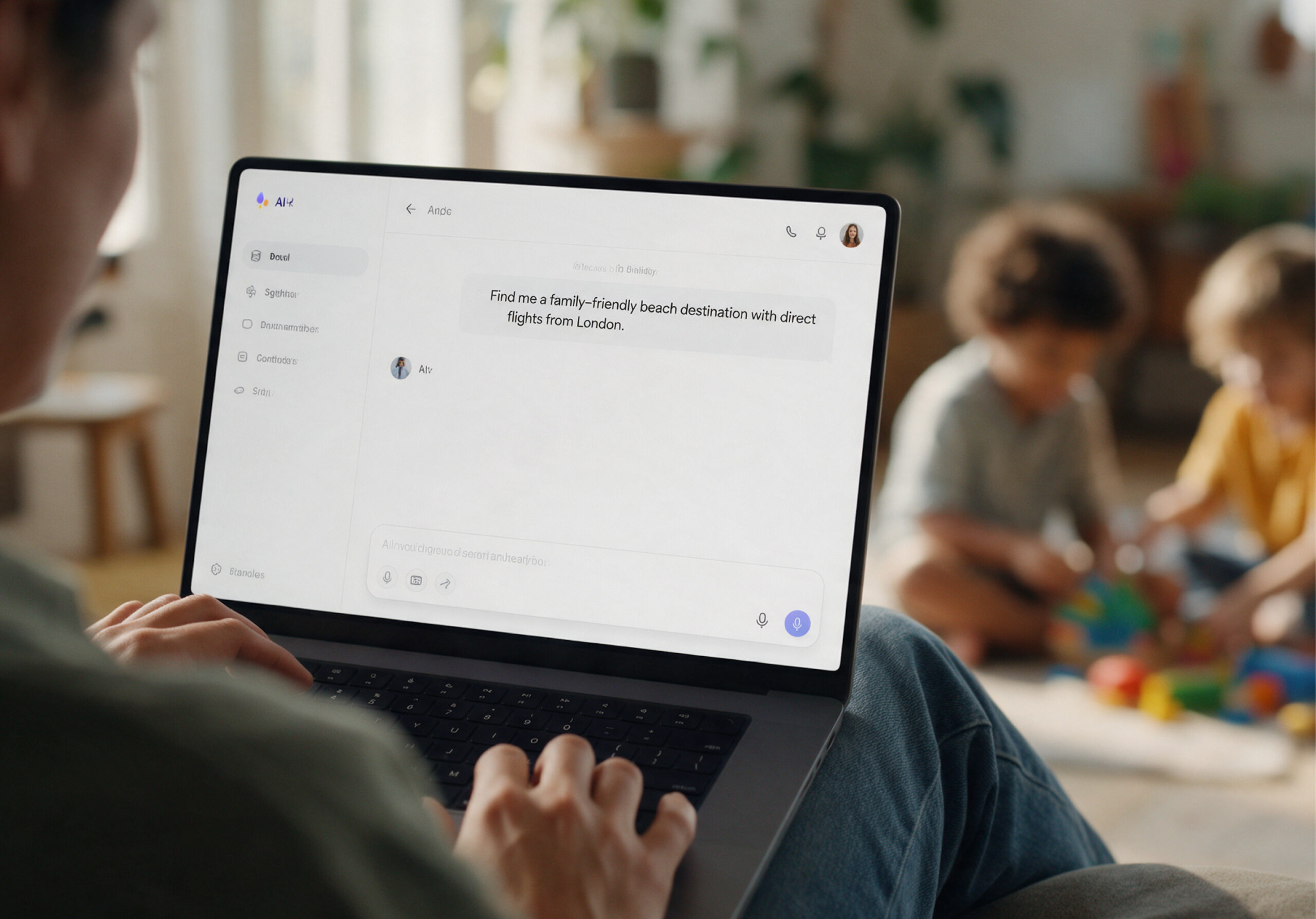
“Find me a family‑friendly beach destination with direct flights from London.”
This shift from search to discovery makes travel planning more intuitive and reduces friction. But it also reshapes how travellers evaluate brands.
AI is not yet the first touchpoint – but it is the new validator
Despite rapid adoption, AI tools are rarely the first platform travellers use when searching for holiday information. In the UK, only 7% begin with an AI chatbot, compared with 44% who start with search engines (Mintel, Travel and AI – UK, 2026; Mintel, Consumers and Online Search Habits – UK, 2026).
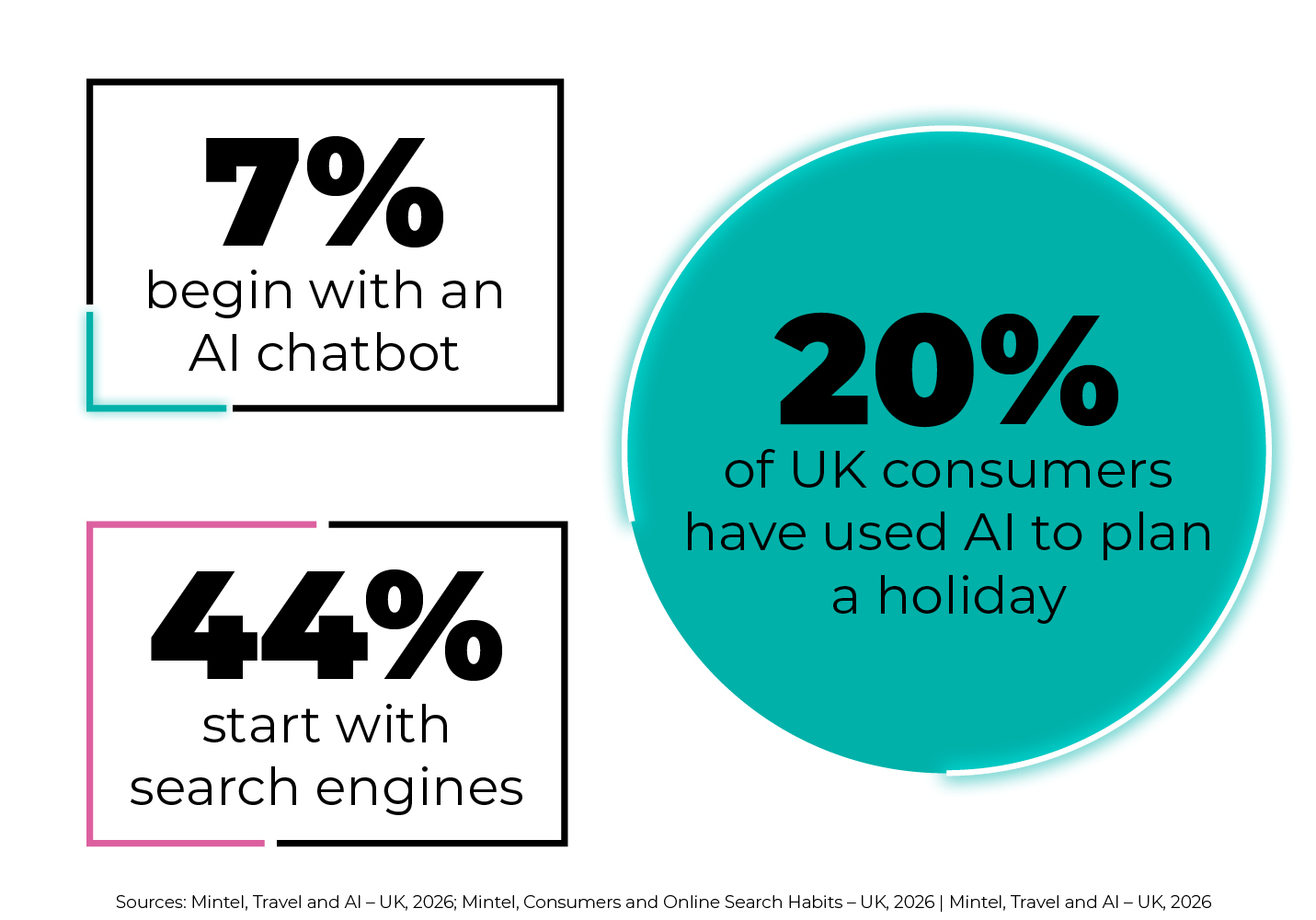
Even so, usage is emerging: 20% of UK consumers say they have used AI to plan a holiday (Mintel, Travel and AI – UK, 2026). And we can anticipate that these numbers will grow rapidly.
This positions AI as a validation layer – a place travellers go to refine, compare, and personalise options they discovered elsewhere.
Marketing implication: SEO is no longer enough
Brands must now optimise for AI-generated answers through Answer Engine Optimisation (AEO) and Generative Engine Optimisation (GEO), or risk becoming less visible. Search is no longer only about ranking in conventional results; it is also about creating content that AI systems can interpret, trust and use when curating personalised answers.
AEO focuses on structuring content so answer engines can respond directly to a user’s question, while GEO focuses on helping generative AI systems find, interpret and cite a brand accurately. Together, they extend traditional SEO rather than replacing it.
How to optimise for AI-generated answers
Earned media is one of the most influential drivers of brand visibility in AI-generated responses, as AI systems tend to place significant weight on trusted third-party validation and authoritative sources. Research suggests that trusted media, where claims are independently reviewed and verified by journalists and editors, can play a substantial role in shaping how large language models assess brand reputation and authority.
However, earned media alone is not enough. Successful AI Overview, AEO (Answer Engine Optimisation) and GEO (Generative Engine Optimisation) strategies also rely on high-quality owned content, strong technical SEO foundations, clear site structure, structured data, and consistent brand signals across the web. AI platforms need to be able to discover, understand and trust your content before it can be surfaced in responses.
Alongside media coverage, third-party review sites such as Trustpilot, peer communities and forums such as Reddit, industry rankings, aggregators, and independent recommendations can all influence AI-generated answers. Proprietary research is particularly valuable, with original data, white papers and primary research often cited because they provide unique, authoritative information that AI systems can reference.
To maximise visibility in AI-generated search experiences, organisations should take a balanced approach that combines earned media, authoritative content creation, technical optimisation and reputation management. The brands most likely to appear in AI-generated answers are those that are not only discoverable, but consistently recognised and validated by trusted sources across the wider digital ecosystem.
Fragmented Planning and Generational Differences
AI search doesn’t replace other channels – it joins them. UK travellers now use search engines, social media, and AI tools to plan trips (Mintel, Consumers and Online Search Habits – UK, 2026). This fragmentation varies sharply by age:
-
16–34s: 22% start on social media; 14% start with AI chatbots
-
55+: 2% start on social media; 1% start with AI chatbots
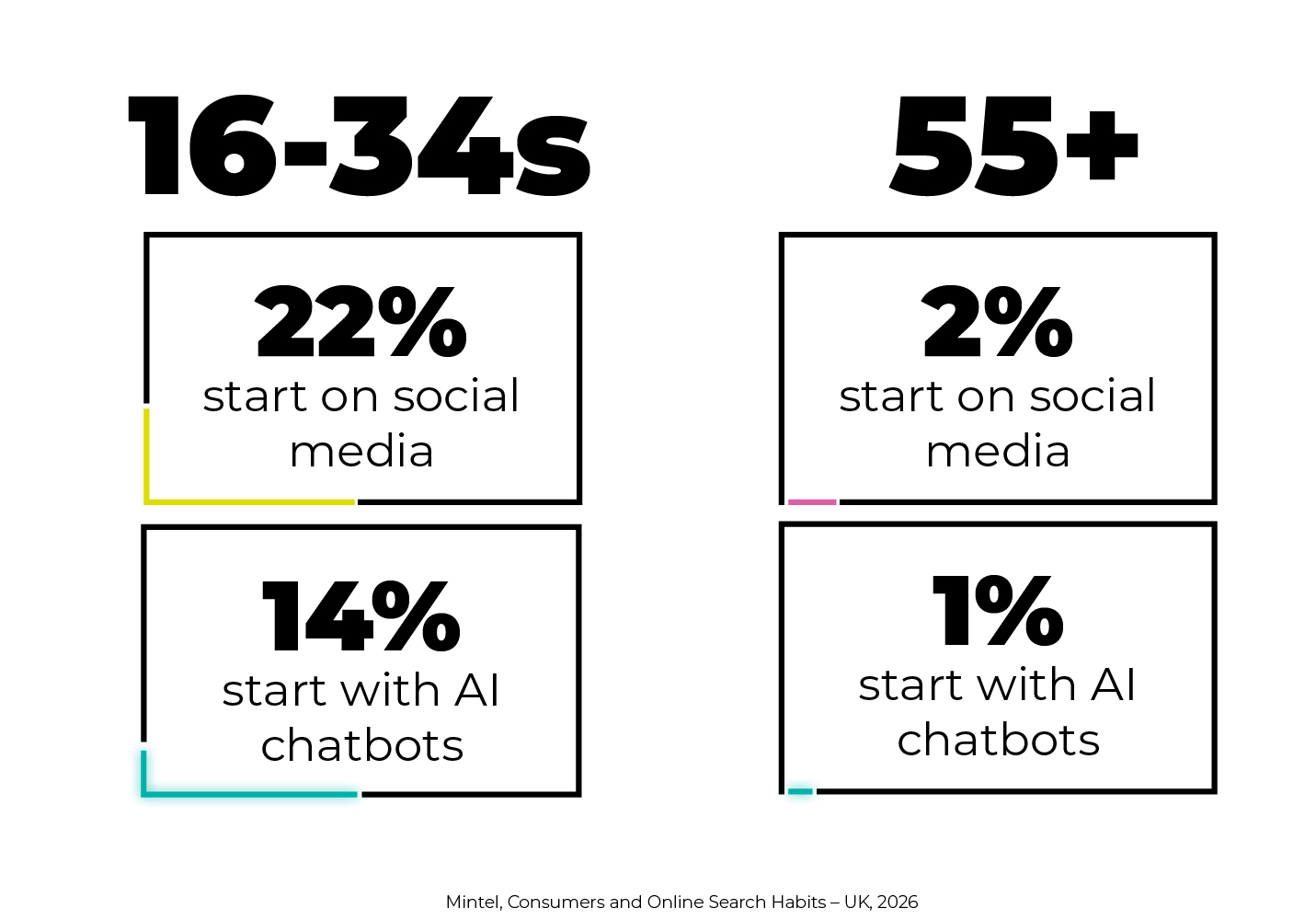
This generational split challenges the idea of a single, linear customer journey. Instead, tourism brands must build multi-channel content ecosystems that serve:
-
search-led planners
-
social-led inspiration seekers
-
AI-led comparison users
One-size-fits-all media plans no longer work. Channel strategy must be audience-specific, behaviour-specific, and format-specific.
Content for Humans and Machines
Destination marketing organisations have long relied on storytelling, imagery, and promotional campaigns. But AI search is changing the rules of engagement.
Among UK consumers who use AI for travel planning, 42% have used it for personalised accommodation recommendations (Mintel, Travel and AI – UK, 2026). This reinforces the value of AI-curated product discovery – and the need for brands to ensure their data is accurate, structured, and up to date.
To appear in AI-driven recommendations, brands must create content that is structured, machine-readable, credible and consistent across platforms. This includes clear headings, bullet points, FAQs, schema markup, rich metadata, accurate geolocation and up-to-date event information.
Travel brands are increasingly advised to produce AI-ready content that chatbots and LLMs can easily interpret (Mintel, Loyalty in Travel – UK, 2026). As AI search becomes habitual, brands must become trusted, data-driven sources that models can reliably extract and recommend (Mintel, Consumers and AI – UK, 2026).
Destinations that invest in digital clarity are rewarded with higher visibility. Those that don’t risk becoming invisible.
Hyper-Personalisation and Agentic Booking – Opportunities Limited by Trust
AI thrives on personalisation. By analysing behaviour, preferences, past trips, and subtle cues in language, AI can tailor recommendations with remarkable precision.
A traveller who frequently books boutique hotels and food-focused experiences will see different suggestions than someone who prefers adventure travel or budget-friendly options. AI adjusts recommendations based on:
-
budget
-
travel style
-
accessibility needs
-
sustainability preferences
-
time constraints
-
group size
-
weather patterns
-
seasonal events
This level of personalisation was once the domain of high-end travel agents. Now it’s available to anyone with a smartphone.
However trust remains the limiting factor
Consumers perceive general AI chatbots as more inaccurate (13%) than friends or family (4%) (Mintel, Travel and AI – UK, 2026). In travel, errors carry serious consequences – missed flights, incorrect opening hours, or misleading safety information.
As a result, 41% of travellers prefer brands that guarantee human customer service (Mintel, Travel and AI – UK, 2026). AI should augment, not replace, human reassurance.
The brands that thrive will be those that blend automation with human expertise.
A More Intelligent Future for Tourism
AI search is still evolving. In the coming years, we can expect:
-
real-time crowd prediction
-
AI-guided tours using augmented reality
-
personalised sustainability scoring
-
emotion-aware travel recommendations
-
AI-powered translation
-
predictive booking tools
The tourism brands best placed to benefit will treat AI search as part of a wider discovery ecosystem, not as a standalone channel. They will make their information easy for machines to interpret, earn validation from trusted sources, and retain human support where travellers need reassurance.
AI Search Optimisation for Tourism: Is Your Destination Ready?
Golley Slater combines tourism marketing expertise with advanced SEO, AI Search Optimisation (GEO & AEO), content strategy and performance media to help destinations remain visible in an evolving search landscape. With experience supporting leading tourism organisations and destinations, and as an independent, employee-owned agency, we focus on delivering measurable outcomes rather than meeting media sales targets.
Whether you’re a destination, attraction, hospitality brand or tourism organisation, we’d be happy to review your current search visibility and identify opportunities to strengthen your presence across Google and emerging AI-powered search platforms.
Talk to our tourism and search specialists today.
Kelly Mitchell,
Digital Performance Director, Golley Slater
Sources
-
Mintel, Travel and AI – UK, 2026
-
Mintel, Consumers and Online Search Habits – UK, 2026
-
Mintel, Loyalty in Travel – UK, 2026
-
Mintel, Consumers and AI – UK, 2026