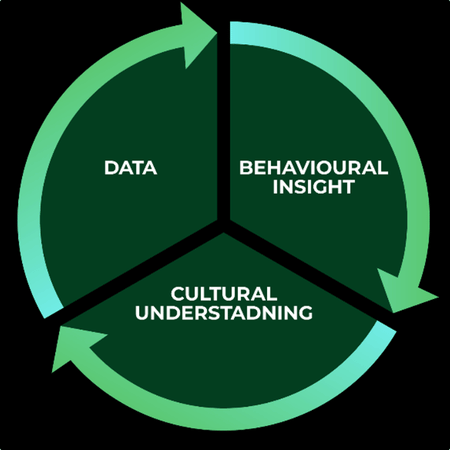
Three types of evidence that shape better decisions
I’ve found it useful to think about evidence in three buckets. It’s not a hard-and-fast rule, more of a lens, a bit of structure to make decision-making feel a little easier. Each one answers a different question. Each has real strengths and real limitations. And the strongest strategies use all three.
Let me bring it to life with a campaign we ran for Transport for Wales (TfW).
The brief was a serious one. Between April 2021 and March 2022, 15 people lost their lives trespassing on railway lines, and Cardiff and the Valleys saw over 1,000 recorded instances of anti-social behaviour on the railway. With the rollout of overhead line equipment as part of the Metro electrification, those lines were now carrying 25,000 volts. Behaviour that had always been risky had become potentially fatal. We needed to keep people safe.
Here’s how the three types of evidence each did their bit.
- Data – what is happening?
This is the evidence we all know well. Performance metrics, tracking data, dashboards, survey numbers. It’s brilliant for describing scale, spotting patterns and telling you what is going on.
What it rarely tells you is why. It shows you the behaviour, not the motivation behind it. And the moment we treat data as the whole picture, decision-making starts to get harder.
For TfW, we were handed a vast Excel document – line after line of every recorded incident: what happened, when, where, and who was involved. From that, we could see exactly who was most likely to be trespassing, where, and when. It pointed clearly to young males in the Valleys regions. But it didn’t tell us the one thing we most needed to know: why they were doing it.
- Behavioural insight – why is it happening?
This is where we move from what to why. It doesn’t come with the neat numbers of a dashboard, and it doesn’t scale in the same way, which is exactly why it so often gets under-played in decisions. It’s harder to gather and it can cost more, so it quietly gets squeezed out. That’s a mistake.
We ran focus groups with young males living along the Valley lines. And what we heard reframed everything. To them, they weren’t doing anything wrong. They’d grown up taking shortcuts across the tracks on the way home from school, or nipping over to fetch a football. It wasn’t malicious. It wasn’t, in their minds, even dangerous. It was just what you did – and had been for generations.
That was the unlock. The big change was that the electrification made it lethal even when no train was coming. Which led us straight to the core insight: something they’d always got away with, they were now unlikely to get away with again. And that became the campaign platform – No Second Chances.
- Cultural understanding – what does this mean in context?
This is the context that behaviour sits within, social norms, language, identity, community dynamics, the cultural signals an audience reads without thinking. It’s what makes a campaign feel like it belongs to people rather than being aimed at them. In a place like Wales, where cultural, linguistic and regional identity carry so much weight, you ignore it at your peril.
It’s arguably the most important of the three and by some distance the hardest. Its biggest limitation is that we assume we understand it, when we often don’t.
From our audience, we learned that old-school safety messaging simply didn’t wash. It switched them off. So, we borrowed from the world they were actually living in. At the time, Vinted and Depop and the whole vintage-fashion resale scene were part of their zeitgeist. So, we leaned into it, which included setting up a pop-up “shop”, where the clothes weren’t for sale but had been made to look as though they’d been through the electrified line. A deadly serious message, told in a language that audience actually spoke.