
Dan Griffiths,
Most marketing teams have more campaign data than they’ve ever had before.
We can track impressions, engagement, clicks, views, conversions, recall, sentiment and dozens of other metrics. Dashboards are richer than ever. Reporting packs are longer than ever.
Yet when someone asks a simple question:
So, did the campaign work?
The answer is often less clear than it should be.
I’ve sat in plenty of meetings where everyone agreed the metrics looked strong, only for the conversation to stall when someone asked whether the campaign had actually made a difference.
That’s because many campaign reports tell us what happened. Far fewer tell us whether it mattered.
And that’s the difference between reporting and effectiveness.
We’re often mistaking efficiency for effectiveness
One of the biggest lessons I’ve learned during my career is that efficiency and effectiveness aren’t the same thing.
Early on, I definitely treated them as if they were.
I’d build reports packed with data. Reach was up. Engagement was up. Website traffic was up. Everything looked positive. Then somebody would ask whether the campaign had actually achieved what it set out to achieve and I’d realise I’d done a much better job of reporting activity than explaining impact.
Efficiency tells us how well something worked. Effectiveness tells us whether it mattered.
Most of us work in environments where we’re asked to justify budgets, demonstrate value and make decisions quickly. So, it’s understandable that we gravitate towards the metrics we can access most easily.
The challenge is that strong metrics don’t automatically prove a campaign achieved its objective.
They tell us that activity happened.
They tell us people saw something, clicked something or watched something.
What they don’t always tell us is whether anything meaningful changed.
Did behaviour change?
Did perceptions shift?
Did sales increase?
Did the campaign solve the problem it was originally designed to solve?
Those are effectiveness questions, and they’re often much harder to answer.
Effectiveness starts with the objective
One reason evaluation can be challenging is that success doesn’t always look the same.
In a recent Effectiveness Sessions webinar, I used three fictional campaigns to make this point. One was trying to increase reusable cup usage. One was trying to improve perceptions of affordable healthy food. One was trying to sell chocolate bars.
All three campaigns were trying to create change.
But the evidence required to evaluate them was completely different.
If a campaign is designed to change behaviour, behaviour change matters most.
If a campaign is designed to change attitudes, perceptions matter most.
If a campaign is designed to drive sales, sales matter most.
In my experience, it’s easy for evaluations to start with the dashboard rather than the objective..
The more useful approach is to start with the objective and work backwards.
What would success look like?
What evidence would prove we’ve achieved it?
What evidence would suggest we haven’t?
Because different objectives require different evidence.
Turning metrics into a story
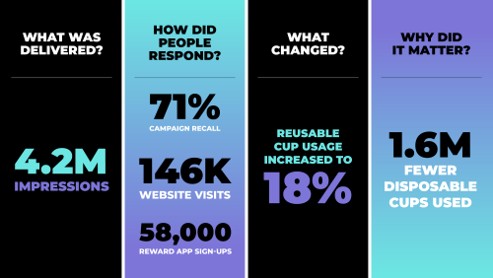
One of the most useful ways I’ve found is to organise campaign evidence around four simple questions:
-
What was delivered?
-
How did people respond?
-
What changed?
-
Why did it matter?
It’s important to recognise that not every metric is trying to answer the same question.